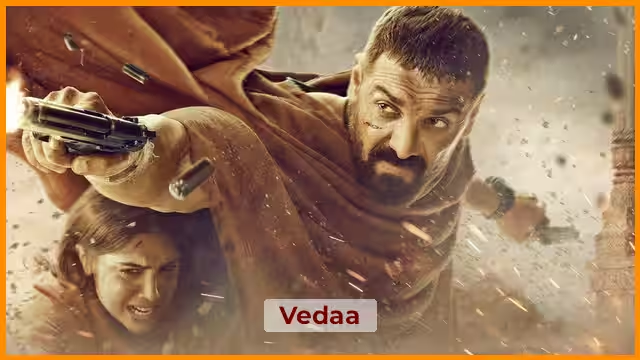
Vedaa Review – When Grit Meets Grace in the Thar
Movie Summary & Story
“Vedaa” thrusts us into the arid expanse of Barmer, a dusty stretch of Rajasthan where the caste hierarchy still casts a long shadow. At the centre of this world is Vedaa (Sharvari), a lower‑caste woman whose daily existence is dictated by rigid social codes and an ever‑present threat of violence. When a powerful landowner, backed by corrupt officials, decides to seize the modest plot that houses her family’s well, Vedaa’s quiet resistance ignites into a full‑blown rebellion.
The stakes are unmistakable: losing the land means not just economic ruin but the erasure of identity for an entire community. Vedaa’s fight therefore becomes a micro‑cosm of a larger battle against systemic oppression. The narrative weaves her personal vendetta with a broader commentary on caste‑based discrimination, gendered vulnerability, and the price of silence.
John Abraham enters as Arjun Singh, a disgraced ex‑police officer who returns to his native village after a scandal. He is drawn to Vedaa’s resolve and, despite his own haunted past, decides to lend his firepower to the cause. Their uneasy alliance fuels the film’s action set‑pieces—high‑speed chases across sand dunes, gritty hand‑to‑hand combat, and a climactic showdown at the village’s ancient stepwell. Yet, the action never overshadows the emotional core; each explosion is underscored by the looming threat of social annihilation. The screenplay, penned by Aseem Arora, balances pulse‑pounding set‑pieces with quiet moments of introspection—Vedaa’s solitary walks at sunrise, her whispered prayers, and the occasional lullaby sung by the village elders that reminds us of a heritage worth protecting.
Cast & Crew Table
| Role | Name |
|---|---|
| Director | Nikkhil Advani |
| Writer | Aseem Arora |
| Producer(s) | Umesh KR Bansal, Monisha Advani, Madhu Bhojwani, John Abraham |
| Cinematographer | Malay Prakash |
| Music (Songs) | Amaal Mallik, Manan Bhardwaj, Yuva, Raghav–Arjun |
| Music (Score) | Kartik Shah |
| Lead Actress | Sharvari (Vedaa) |
| Lead Actor | John Abraham (Arjun Singh) |
| Supporting Actor | Abhishek Banerjee (Vikram) |
| Antagonist | Ashish Vidyarthi (Thakur Ranjit) |
| Production Companies | Zee Studios, Emmay Entertainment, JA Entertainment |
Technical Aspects
Cinematography – Malay Prakash captures Barmer’s stark beauty with a palette that oscillates between sun‑bleached golds and deep, night‑time indigos. The wide‑angle shots of endless dunes create a feeling of isolation, mirroring Vedaa’s loneliness in a society that refuses to see her. Close‑ups are deliberately intimate; the camera lingers on the texture of her hands as she tends to the family’s well, allowing the audience to feel the weight of her labor. The use of natural light during the daytime sequences adds authenticity, while the night scenes employ a subtle teal wash that heightens tension without sacrificing realism.
Music & BGM – The soundtrack is a collaborative effort. Amaal Mallik and Manan Bhardwaj craft melodic numbers that blend contemporary beats with folk instruments like the ravanahatta and sarangi, grounding the film in its Rajasthani setting. The song “Mitti Ki Pukar” (sung by Yuva) becomes an anthem for the village, its chorus echoing during the protest montage. Raghav–Arjun’s upbeat track “Dhoop Ka Saath” accompanies the high‑octane chase across the dunes, its pulsating rhythm syncing perfectly with the rapid cuts. Kartik Shah’s score, however, is the true emotional engine; low, resonant strings underscore Vedaa’s moments of grief, while percussive stings rise during confrontations, amplifying the stakes without overwhelming the dialogue.
Pacing & Editing – The film’s rhythm is deliberate. The first act establishes the oppressive world in a measured pace, allowing viewers to absorb the social context. The second act accelerates as Arjun’s arrival introduces a new tactical dimension; editing becomes tighter, with quick cross‑cuts between the village’s mobilisation and the antagonist’s machinations. The climax, though packed with action, maintains narrative clarity thanks to crisp editing that avoids the typical “over‑cut” syndrome seen in many masala movies. The final 10 minutes transition into a slower, reflective tempo, giving space for the audience to contemplate the film’s message.
Performances & Characters
Sharvari (Vedaa) – Sharvari delivers a breakout performance, embodying a blend of fierce determination and vulnerable humanity. Her eyes convey a simmering fury that rarely needs dialogue, while her physicality—whether she’s wielding a makeshift weapon or tending to a child—feels authentic. She avoids melodrama, opting instead for a grounded portrayal that makes her struggle palpable.
John Abraham (Arjun Singh) – Abraham’s presence is unmistakable. He brings his trademark intensity to the role, but he also reveals a softer side when he shares quiet moments with Vedaa. His chemistry with Sharvari is built on mutual respect rather than romance, which feels refreshing in a genre that often defaults to a love subplot.
Abhishek Banerjee (Vikram) – As the village’s schoolteacher turned reluctant activist, Banerjee provides the intellectual backbone to the rebellion. His measured delivery adds gravitas, and his occasional comic relief—delivered through wry observations about bureaucracy—lightens the otherwise heavy narrative.
Ashish Vidyarthi (Thakur Ranjit) – Vidyarthi embodies the entrenched feudal mindset with a chilling calm. His performance is menacing without resorting to over‑the‑top villainy; the way he pauses before delivering a decree underscores the calculated cruelty of caste oppression.
The supporting cast, including local actors portraying villagers, adds texture, ensuring the community feels lived‑in rather than a backdrop.
Box Office & Collection
“Vedaa” has yet to hit the theatres, with its release slated for 15 August 2024. Pre‑release buzz suggests a strong opening, especially in North Indian markets where the social themes resonate. The film’s modest budget—estimated at ₹120 crore—combined with its multi‑language rollout (Hindi, Tamil, Telugu) positions it to recover costs quickly, provided the word‑of‑mouth sustains. Early tracking indicates potential first‑week collections in the ₹70‑80 crore range, a healthy start for a socially driven action drama.
What Works & What Doesn't
Pros
- Authentic setting: Desert cinematography immerses the viewer in Barmer’s Mr Amon beauty.
- Strong thematic core: Tackles caste discrimination with sincerity, avoiding preachiness.
- Sharvari’s breakout performance: Carries the emotional weight of the film.
- Balanced action: Fight sequences are gritty yet purposeful, never merely spectacle.
- Music integration: Songs and score enhance mood without breaking narrative flow.
Cons
- Predictable antagonist arc: Thakur Ranjit’s downfall follows familiar beats.
- Occasional pacing lag: The first half, while necessary for context, feels slower for viewers seeking pure action.
- Limited female camaraderie: Vedaa’s journey is largely solitary; more focus on sisterhood could have enriched the narrative.
My Rating & Final Verdict
Rating: 4.2 / 5
“Vedaa” manages to fuse the raw energy of a masala action film with the gravitas of a socially conscious drama. Its strengths lie in a compelling central performance, evocative visuals, and a soundtrack that feels both contemporary and rooted in tradition. While certain narrative turns tread familiar ground, the film’s heart beats strongly for those yearning for cinema that entertains and enlightens. If you appreciate stories where the fight for justice is as visceral as the gun‑fire, “Vedaa” is a must‑watch.