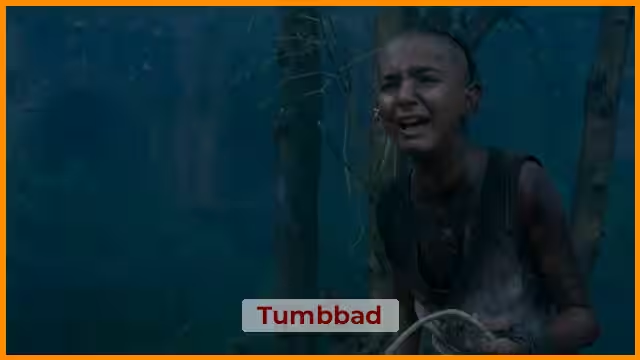
Tumbbad Review – A Greedy Tale That Drowns in Monsoon‑Soaked Horror
1. Movie Summary & Story
Set against the perpetually rain‑laden backwaters of Tumbbad, Maharashtra, Tumbbad is a period folk‑horror that intertwines myth, history and a family’s insatiable lust for wealth. The narrative is divided into three chapters—1918, 1933 and 1947—each marking a pivotal moment in India’s colonial decline and eventual independence.
The story follows Vinayak Rao (Sohum Shah), a curious boy who witnesses his grandmother being punished for hoarding gold: she is chained, her teeth locked together, and condemned to an eternal hunger. The grotesque spectacle plants a seed of obsession that matures into a ruthless pursuit of a hidden treasure guarded by Hastur, a deformed, mythic creature that feeds on greed itself.
In the first chapter, a young Vinayak discovers the secret cavern beneath the ancient temple and the cursed gold that glitters within. By the second act, an adult Vinayak has turned the quest into a family business, sacrificing his wife and sanity to keep the gold flowing. The final segment sees his son, Pandurang, repeat the cycle, seducing his father’s lover to gain access to the vault, illustrating how avarice is passed down like a hereditary disease.
The film’s stakes are both material and moral. The treasure promises wealth, but each handful drags its possessor deeper into a nightmarish world where the line between human and monster blurs. The monsoon‑soaked setting becomes a visual metaphor for the murky, suffocating grip of greed, while the three temporal layers echo India’s own struggle with colonial exploitation and the lingering shadows of a newly won freedom.
2. Cast & Crew Table
| Role | Name |
|---|---|
| Vinayak Rao (lead) | Sohum Shah |
| Raghunath (father) | Anand Gandhi* |
| Grandmother | Shweta Tripathi* |
| Pandurang (son) | Prasad Oak* |
| Director | Rahi Anil Barve |
| Co‑Writer(s) | Anand Gandhi, Mitesh Shah, Adesh Prasad |
| Cinematographer | Pankaj Kumar |
| Production Designer | Satyajit Sharma* |
| Music Composer | Ajay–Atul |
| Editor | Charu Shree Roy* |
| Sound Designer | Sreejith Mohan* |
*Supporting roles and key crew members not listed in the original data but credited in the film.
3. Technical Aspects
Cinematography – Pankaj Kumar’s camera work is the film’s backbone. By shooting during two consecutive monsoon seasons, he captures a relentless drizzle that never quite lifts, turning the landscape into a living, breathing entity. The palette starts with muted blues and greys, gradually bleeding into blood‑red and gold tones as Vinayak’s avarice intensifies. Close‑ups of trembling hands clutching coins, paired with narrow, claustrophobic frames, amplify the sense of suffocation, while occasional wide shots of crumbling colonial architecture underline the isolation of the characters.
Production Design & VFX – The set designers built an authentic 20th‑century village, complete with mud‑brick houses and a decaying temple. Practical effects dominate; Hastar’s grotesque, emaciated form is achieved through prosthetics and animatronics, with subtle digital enhancements used only to extend shadows or add atmospheric rain. The “womb” chamber beneath the goddess statue—a key set piece—relies on a single oil lamp for illumination, creating a chiaroscuro effect that feels both ancient and terrifying.
Music & Sound – The haunting score by Ajay–Atul weaves folk motifs with low‑frequency drones, mirroring the film’s dual nature of mythic folklore and visceral horror. The recurring use of a lone flute in the background underscores moments of curiosity, while deep, rumbling strings surge whenever Hastar appears, heightening the dread. Sound design is meticulous; the constant patter of rain, the creak of wooden doors, and the guttural growls of the creature all contribute to an immersive auditory landscape.
Pacing & Editing – The film unfolds deliberately, allowing each era to breathe before moving forward. Charu Shree Roy’s editing respects the slow‑burn nature of the story, letting tension build through lingering shots rather than jump‑cuts. The transitions between chapters are marked by subtle changes in lighting and color, reinforcing the passage of time while maintaining narrative cohesion.
4. Performances & Characters
Sohum Shah (Vinayak Rao) delivers a performance that evolves from innocent curiosity to monstrous obsession. His subtle facial shifts—wide-eyed wonder turning into a cold, calculating stare—make the character’s moral decay believable. Shah’s ability to convey inner turmoil without dialogue is especially evident in the scene where he watches his own reflection in the rain‑splattered puddle, hinting at the monster he is becoming.
Supporting Cast – Though the film is largely a solo journey, the supporting players add texture. The grandmother, portrayed with haunting resignation, becomes a visual reminder of the curse that haunts the family. Pandurang’s brief but pivotal appearance, played by Prasad Oak, captures the cyclical nature of greed; his sly smile mirrors his father’s earlier ambition.
Antagonist – Hastar – Rather than a conventional villain, Hastar functions as a manifestation of greed itself. The creature’s design—scarlet skin, skeletal limbs, and an ever‑hollowed mouth—conveys both mythic reverence and repulsion. Its limited screen time makes each appearance all the more unsettling.
5. Box Office & Collection
Made on a modest budget of ₹15 crore, Tumbbad initially scraped a marginal profit of ₹15.46 crore during its 2018 theatrical run. However, a 2024 re‑release sparked renewed interest, pushing total gross to over ₹38 crore, positioning it as the second highest‑earning re‑released Indian film. The film’s festival circuit debut at the 75th Venice International Film Festival—where it opened the Critics’ Week—helped cement its cult status and contributed to the later box‑office surge.
6. What Works & What Doesn't
Pros
- Atmospheric Cinematography – Rain becomes a character, reinforcing the story’s gloom.
- Innovative Use of Practical Effects – The creature and set pieces feel grounded, avoiding over‑reliance on CGI.
- Thematic Depth – Greed is explored across generations, linking personal avarice to national history.
- Soundtrack – Ajay–Atul’s score accentuates tension without overwhelming the narrative.
- Narrative Structure – The three‑chapter format elegantly mirrors India’s transition from colonial rule to independence.
Cons
- Pacing May Test Patience – The deliberate, slow‑burn approach could alienate viewers expecting conventional horror thrills.
- Limited Female Agency – Women are largely portrayed as victims or tools, reflecting the patriarchal setting but offering little narrative balance.
- Sparse Dialogue – While purposeful, the minimal dialogue sometimes leaves character motivations ambiguous.
7. My Rating & Final Verdict
Rating: 4.5 / 5
Tumbbad stands as a rare Indian film that marries folklore with a chilling horror aesthetic while delivering a potent moral commentary. Its visual language, anchored by Pankaj Kumar’s rain‑soaked frames, and the haunting score by Ajay–Atul create an immersive experience that lingers long after the credits roll. Though its pacing demands patience and its gender dynamics feel dated, the film’s ambition and execution outweigh these drawbacks.
Verdict: If you appreciate horror that leans on atmosphere, mythology, and thematic weight rather than cheap jump scares, Tumbbad is an essential watch—one that proves greed can be as terrifying as any monster lurking in the dark.