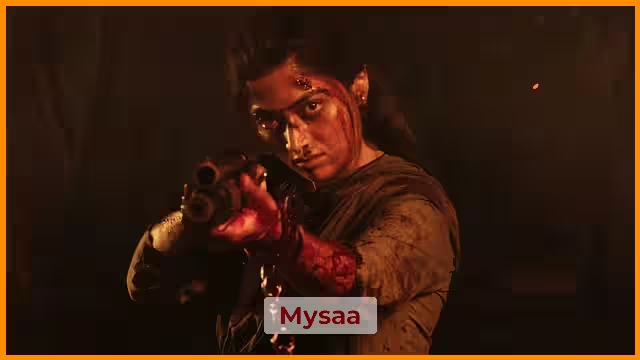
Mysaa Review – A Tribal Fury That Redefines the Female Action Hero
Movie Summary & Story
Set against the raw, untamed landscape of the pre‑colonial Gond belt, Mysaa follows the harrowing odyssey of a young tribal woman who transforms tragedy into a relentless quest for vengeance. Rashmika Mandanna stars as the eponymous warrior, a fierce Gond fighter whose family is mercilessly slaughtered by the opportunistic warlord Shatru (Rao Ramesh). The opening sequences plunge us into a world where folklore and brutal reality coexist: ancestral spirits whisper through the forest, and the thunderous roar of a waterfall becomes a visual metaphor for Mysaa’s inner turbulence.
The narrative weaves flashbacks of Mysaa’s tender bond with her parents—portrayed by Guru Somasundaram and Easwari Rao—against the present‑day blood‑soaked trek across rugged terrain. These moments of love and loss create a stark emotional contrast that fuels her ferocity. As she battles mercenaries, navigates tribal politics, and confronts the mythic warrior goddess of her people, the film explores themes of female empowerment, cultural identity, and resistance against colonising forces. The climax, staged at a cascading waterfall, is both a literal and symbolic showdown, where Mysaa must decide whether to become a legend or simply survive.
Beyond the revenge plot, the film layers a subtle political commentary: Shatru’s exploitation of tribal lands mirrors historic plunder, while Mysaa’s defiance becomes an allegory for indigenous self‑determination. The screenplay balances high‑octane action with moments of quiet introspection, allowing the audience to feel the weight of each loss and the fire behind every strike.
Cast & Crew Table
| Role | Name |
|---|---|
| Director | Rawindra Pulle (debut) |
| Producer | Unformula Films |
| Lead (Mysaa) | Rashmika Mandanna |
| Antagonist (Shatru) | Rao Ramesh |
| Father | Guru Somasundaram |
| Mother | Easwari Rao |
| Cinematographer | Shreyaas P Krishna |
| Music Composer | Krishna Vasa |
| Action Choreographer | Andy Long |
| Production Designer | (Not disclosed) |
| Editor | (Not disclosed) |
Technical Aspects
Cinematography – Shreyaas P Krishna treats the Deccan plateau as a character in its own right. Low‑angle shots elevate Mysaa to mythic stature, while sweeping wide frames capture the isolation of the forest, the crimson glow of sunset, and the mist‑laden waterfalls. The use of natural lighting gives the film a tactile realism that grounds its larger‑than‑life moments.
Music & Background Score – Composer Krishna Vasa blends tribal drums, bansuri flutes, and indigenous chants with a full orchestral backdrop. The title track, already a festival favourite, fuses raw percussion with soaring strings, echoing Mysaa’s inner conflict. During battle sequences, the rhythmic pounding of drums heightens tension, while softer, melodic motifs accompany flashbacks, reinforcing the emotional stakes.
Editing & Pacing – The film maintains a brisk rhythm in its first half, propelled by tightly cut combat scenes and rapid transitions between present danger and past memories. A brief lull appears midway when the lore of the Gond goddess is explained; the exposition, though rich, slows the momentum slightly. However, the editor regains control as the story accelerates toward the waterfall climax, delivering a satisfying crescendo.
Action Choreography – Andy Long’s fight design rejects exaggerated wirework in favour of grounded, gritty combat. Rashmika’s months‑long martial‑arts training shines through every clash, making each strike feel earned. The choreography respects tribal fighting styles, incorporating improvised weapons and close‑quarter grappling that feels both authentic and visceral.
Production Design & VFX – With a budget hovering between ₹80–₹100 crore, the film invests heavily in recreating a believable pre‑colonial setting. VFX enhances large‑scale battlefields and the roaring waterfall, yet never overshadows the practical sets built from locally sourced timber and stone, preserving the film’s earthy texture.
Performances & Characters
Rashmika Mandanna (Mysaa) – The star sheds her usual glamorous persona for a raw, muscular embodiment of a tribal warrior. Her transformation is evident not just in the physicality—visible tattoos, a leaner frame, and a scarred visage—but also in her nuanced delivery. She oscillates between ferocious rage and fleeting vulnerability, especially in scenes with her parents. The guttural scream she lets out in the December‑24 glimpse encapsulates the character’s unbreakable spirit.
Rao Ramesh (Shatru) – As the cunning warlord, Rao Ramesh brings a chilling composure. His calculated cruelty feels grounded, making the audience genuinely fear his machinations. The subtle shift from diplomatic veneer to outright brutality adds layers to the antagonist, preventing him from becoming a mere plot device.
Guru Somasundaram & Easwari Rao (Parents) – Their brief but poignant screen time provides the emotional anchor for Mysaa. Their warm interactions are shot with soft lighting, contrasting sharply with the Mr Amonness of the later sequences, thereby amplifying the stakes of Mysaa’s loss.
Supporting Tribe Members – Though not individually highlighted, the ensemble of tribal fighters contributes authenticity. Their performances, aided by regional dialect coaching, enrich the cultural tapestry and reinforce the collective struggle against oppression.
Box Office & Collection
As of now, Mysaa is yet to hit theatres (scheduled for 1 December 2025). Pre‑release tracking indicates strong anticipation across the five language markets, driven by Rashmika’s pan‑India fanbase and the buzz generated by the June‑27 title reveal. Industry analysts predict the film will comfortably recover its ₹80–₹100 crore budget, especially if the multilingual release strategy mirrors the success of recent pan‑India ventures.
What Works & What Doesn’t
Pros
- Rashmika’s physically demanding, emotionally resonant performance.
- Authentic depiction of Gond culture through music, costumes, and set design.
- Visually striking cinematography that treats the landscape as a narrative force.
- Gritty, realistic action choreography that avoids over‑stylisation.
- Strong thematic core exploring female agency and indigenous resistance.
Cons
- Mid‑film exposition on tribal mythology slows the pacing slightly.
- Some secondary characters lack depth, serving mainly as plot catalysts.
- The ambitious VFX, while impressive, occasionally draws attention to its artificiality during large‑scale battle scenes.
My Rating & Final Verdict
Rating: ★★★★☆ (4 out of 5)
Verdict: Mysaa delivers a powerful blend of cultural authenticity and high‑energy action, anchored by Rashmika Mandanna’s career‑defining turn as a tribal avenger. While the lore‑heavy middle section tests patience, the film’s visual grandeur, resonant music, and unapologetic female empowerment make it a must‑watch for audiences craving a fresh, regionally rooted epic. Expect the waterfall climax to linger in your mind long after the credits roll.