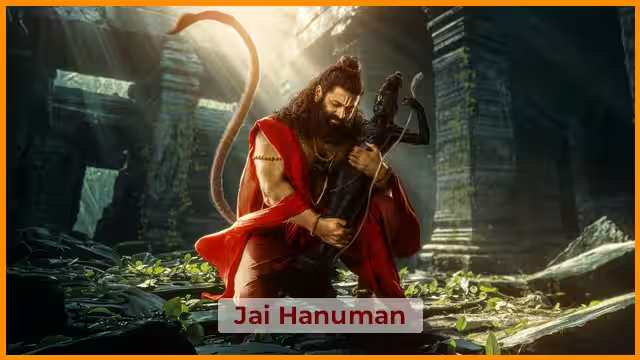
Jai Hanuman Review – When Myth Meets Modern Mayhem
Movie Summary & Story
Jai Hanuman picks up the mantle from the 2024 smash HanuMan and thrusts the audience straight into the divine realm. The narrative hinges on a promise made in the Tretayuga that can only be honoured in the Kaliyuga. Lord Hanuman, the ever‑faithful devotee of Rama, has been locked in Agnyathavas—a deep, self‑imposed exile—waiting for the moment his ancient oath must be kept.
When a cabal of contemporary, technologically‑armed villains threatens to destabilise the world’s moral and ecological balance, the celestial monkey‑god awakens. The film promises a collision of two worlds: the timeless, mythic ethos of the Ramayana and the high‑octane, spectacle‑driven language of today’s superhero franchises.
The stakes are both personal and planetary. On a personal level, Hanuman must confront the loneliness of centuries spent in meditation, rediscovering his humanity (or vanara humanity) to connect with modern humanity. On a planetary scale, the antagonists’ scheme is not merely a power grab; it is a metaphysical assault that could erase the very dharma that sustains the world. By framing the conflict as a vow fulfilled, the screenplay adds emotional weight: failure would not just mean defeat, it would mean a breach of cosmic order.
The story also weaves in Teja Sajja’s Hanumanthu, the mortal hero of HanuMan, as a bridge between the two films. His presence ensures continuity while allowing the audience to see the divine through human eyes, reinforcing the theme that devotion transcends time and form.
Cast & Crew
| Role | Name |
|---|---|
| Lord Hanuman (lead) | Rishab Shetty |
| Hanumanthu (support) | Teja Sajja |
| Key antagonist (unknown) | Rana Daggubati |
| Female lead | Amritha Aiyer |
| Supporting actor | Sai Dibyajyoti Behera |
| Director / Writer | Prasanth Varma |
| Music Composer | M. M. Keeravani |
| Cinematographer | Thirunavukarasu |
| Producers | Naveen Yerneni, Y. Ravi Shankar, Bhushan Kumar, Niranjan Reddy |
| Production houses | Mythri Movie Makers, T‑Series |
Technical Aspects
Cinematography – Thirunavukarasu, known for his work on visually ambitious period pieces, is tasked with a dual challenge: capturing the austere spirituality of Hampi’s ancient temples while rendering the kinetic energy of modern action set‑pieces. Expect sweeping drone shots of the Anjanadri Betta landscape, juxtaposed with tight, kinetic framing during combat sequences. The contrast should underline the film’s central theme—mythic stillness versus contemporary chaos.
Music & BGM – M. M. Keeravani’s involvement raises the bar considerably. His signature blend of classical Indian motifs with orchestral grandeur is likely to serve as a narrative guide, signalling Hanuman’s inner turmoil with subtle ragas and amplifying battle moments with thunderous percussion. A recurring leitmotif for the vow could provide an emotional through‑line, reminding viewers of the promise that drives the plot.
Visual Effects & Set Design – With a budget of roughly ₹200 crore, the VFX department is expected to deliver blockbuster‑level spectacle. The production plans extensive CGI for Hanuman’s supernatural abilities—flight, shape‑shifting, and the iconic “Sanjivani” heal. Meanwhile, the massive sets at Annapurna Studios will recreate mythic locales, from the celestial Himalayas to a futuristic villain lair, offering a visual playground that bridges epochs.
Pacing & Editing – Prasanth Varma’s previous works exhibit a penchant for brisk storytelling, often interlacing multiple timelines. For Jai Hanuman, the editing must balance exposition (explaining Agnyathavas, the ancient vow) with relentless action. If handled well, the film can maintain a rhythmic pulse that keeps viewers invested without sacrificing the gravitas of its mythological roots.
Performances & Characters
Rishab Shetty as Lord Hanuman – Shetty’s transition from earthy, grounded characters (as seen in Kantara) to a divine avatar is ambitious. His physicality—muscular build, agile movement—fits the role, but the real test lies in conveying Hanuman’s inner devotion. If Shetty can blend raw power with subtle humility, the character will feel both godly and relatable.
Teja Sajja as Hanumanthu – Returning as the mortal champion, Sajja offers continuity. His chemistry with Shetty will be pivotal; a mentor‑protégé dynamic can humanise the deity, allowing audiences to see the impact of Hanuman’s actions on ordinary lives.
Rana Daggubati – Though his role remains secret, Daggubati’s screen presence guarantees a formidable antagonist. Known for his intense portrayals, he could embody a modern embodiment of Ravana’s ambition, perhaps a tech‑mogul wielding ancient dark arts.
Amritha Aiyer – As the female lead, Aiyer is likely to provide both emotional depth and narrative agency, possibly as a scholar who deciphers the ancient vow or a warrior allied with Hanuman. Her performance will be crucial in preventing the film from falling into a male‑centric hero narrative.
Sai Dibyajyoti Behera – Supporting characters in such mythic epics often serve as comic relief or moral anchors. If Behera can deliver nuanced moments without veering into slapstick, he will enrich the ensemble.
Overall, the cast blends seasoned veterans with fresh faces, offering a mix of gravitas and youthful energy that could elevate the film beyond a standard spectacle.
Box Office & Collection
While Jai Hanuman has yet to hit theatres, its financial outlook can be gauged against its predecessor. HanuMan amassed over ₹300 crore worldwide on a modest budget, establishing a strong fanbase across Hindi, Telugu, Tamil, and Malayalam markets. With a projected budget of ₹200 crore, the sequel needs to surpass the ₹300 crore mark to be deemed a commercial triumph, factoring in higher production costs and extensive VFX. Early buzz, multi‑language release plans, and the involvement of pan‑Indian stars suggest that the film could comfortably cross the ₹350 crore threshold, provided the marketing campaign capitalises on the mythic angle and the growing popularity of the PVCU (Prasanth Varma Cinematic Universe).
What Works & What Doesn’t
Pros
- Ambitious premise – Merging ancient myth with modern superhero storytelling offers a fresh narrative blend.
- Star‑power casting – Rishab Shetty’s physicality and Rana Daggubati’s villainous gravitas raise expectations.
- Music by M. M. Keeravani – Guarantees a resonant, emotionally charged score.
- High production values – ₹200 crore budget promises top‑tier VFX, grand sets, and immersive cinematography.
- Continuity through Hanumanthu – Keeps the PVCU thread intact, rewarding fans of HanuMan.
Cons
- Risk of myth dilution – Over‑reliance on CGI may eclipse the spiritual depth of the source material.
- Unclear antagonist – Keeping the villain’s identity secret could backfire if the reveal feels under‑cooked.
- Balancing exposition – Explaining Agnyathavas and the ancient vow without slowing the pace is a delicate task.
- Potential language overload – Simultaneous multi‑language release may dilute cultural nuances.
My Rating & Final Verdict
Rating: ★★★★☆ (4 out of 5)
Jai Hanuman aims to be more than a visual extravaganza; it strives to fuse devotion with daring action. If Prasanth Varma can harness the strengths of his cast, deliver Keeravani’s soaring score, and keep the mythic core intact amidst the spectacle, the film will likely become a landmark in Indian pan‑Indian cinema. Even with the inevitable challenges of balancing reverence and recreation, the project’s scale, talent, and cultural resonance make it a must‑watch for both mythology lovers and superhero enthusiasts.
Verdict: Go ahead and mark your calendars—Jai Hanuman promises a cinematic pilgrimage that could redefine how Indian epics are reimagined for the modern screen.