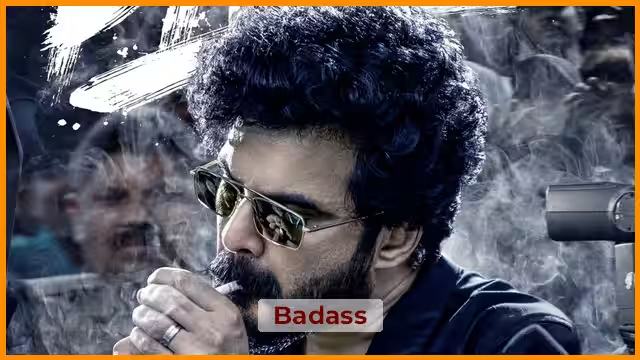
Badass Review – When Rebellion Becomes Romance
1. Movie Summary & Story
Badass arrives as a daring, character‑driven romance that promises to tilt the familiar Telugu hero‑formula on its head. The story follows Siddhu Jonnalagadda’s unnamed protagonist – a brooding, emotionally scarred young man who navigates love, loss, and a society that constantly asks him to compromise his integrity. While the promotional tagline “If middle finger was a man” hints at swagger, the film’s core is far more intimate: a man who, after a series of betrayals, decides to confront his own darkness rather than surrender to it.
The stakes are personal and societal. On the personal front, the protagonist’s love interest (yet to be announced) becomes the catalyst that forces him to confront the trauma that fuels his anger. On the societal front, the narrative explores how a small‑town environment—replete with patriarchal expectations, class divisions, and a relentless chase for quick success—pushes a sensitive soul toward rebellion. The film’s emotional arc is built on a series of flashbacks that reveal why the hero feels “the darkest film in Telugu cinema” is an apt description of his life.
What sets Badass apart from the usual love‑story fare is its willingness to let the romance serve as a conduit for deeper questions: Can a man who has raised his middle finger to every authority ever find redemption? Does love have the power to soften a hardened heart, or does it merely expose the rawness underneath? The screenplay, co‑written by director Ravikanth Perepu and Siddhu himself, leans heavily on internal monologues and visual metaphors—rain-soaked streets, cracked walls, and lingering close‑ups—to externalise the protagonist’s inner turmoil. The film is less about grand gestures and more about the quiet, often painful, moments that define a relationship when both parties are battling their own demons.
2. Cast & Crew Table
| Role | Name |
|---|---|
| Director / Writer | Ravikanth Perepu |
| Lead Actor | Siddhu Jonnalagadda |
| Co‑Writer | Siddhu Jonnalagadda |
| Music Composer | Ram Sampat |
| Producer | S. Naga Vamsi |
| Producer | Sai Soujanya |
| Production House | Sithara Entertainments |
| Production House | Fortune Four Cinemas |
| Presentation | Srikara Studios |
(Supporting actors and technical crew such as cinematographer, editor, and art director have not been officially announced at the time of writing.)
3. Technical Aspects
Cinematography – Although the cinematographer’s name remains under wraps, director Ravikanth Perepu’s earlier work on Krishna and His Leela displayed a penchant for natural lighting and handheld framing that heightened intimacy. Expect Badass to employ a similar visual language: muted colour palettes for the protagonist’s bleak moments, contrasted with richer, saturated tones whenever love flickers on screen. The use of long takes could amplify the feeling of being trapped in the character’s emotional vortex, while occasional slow‑motion sequences may underline the weight of pivotal decisions.
Music & Background Score – Ram Sampat, known for his ability to blend contemporary beats with folk textures, is tasked with underscoring a romance that teeters on the edge of darkness. Anticipate a soundtrack that oscillates between moody, atmospheric tracks during the protagonist’s solitary wanderings and melodic, acoustic‑driven numbers when love surfaces. A well‑placed leitmotif could become the film’s emotional anchor, reminding audiences of the protagonist’s internal conflict each time it resurfaces.
Pacing & Editing – The narrative’s structure, built on flashbacks and present‑day confrontations, demands a tight edit to avoid disorientation. If the editing mirrors the rhythm of the protagonist’s heartbeat—slow and deliberate during introspection, rapid during moments of anger—the audience will feel the same tension. The challenge will be to keep the story moving without sacrificing the contemplative pauses that give the drama its depth.
4. Performances & Characters
Siddhu Jonnalagadda – Known for his breezy, comic timing in the Tillu series, Siddhu takes a bold leap into darker territory. Early teasers suggest a performance that relies heavily on subtle facial expressions rather than dialogue‑driven bravado. If he can convincingly portray a man wrestling with self‑destruction while still retaining a flicker of vulnerability, the role could become a career‑defining milestone. His involvement in the script hints at a personal connection to the material, which often translates into a more authentic on‑screen presence.
Supporting Cast – While the love interest and antagonistic figures are yet to be revealed, the film’s success will hinge on their ability to mirror or challenge the protagonist’s worldview. A well‑cast female lead who can hold her own against Siddhu’s intensity will elevate the romance from a side‑note to a true emotional fulcrum. Likewise, any antagonist—whether a corrupt politician, a ruthless landlord, or an inner‑psychic voice—must embody the societal pressures that drive the hero’s rebellion.
Character Depth – The script’s promise of a “personal and mature narrative” suggests layered secondary characters. Expect friends who act as reluctant confidants, family members who embody generational expectations, and perhaps a mentor figure who offers a glimpse of redemption. Each of these roles, if written and performed with nuance, will enrich the tapestry of the protagonist’s journey.
5. Box Office & Collection
Badass has not yet opened, so concrete numbers are unavailable. The film’s budget is undisclosed, but given the involvement of two mid‑size production houses and a modest cast, it likely falls within the ₹30–₹45 crore range. The key to its commercial recovery will be the strength of its pre‑release buzz—particularly the striking first‑look poster and the reputation of Siddhu‑Perepu’s previous collaboration, which turned Krishna and His Leela into a sleeper hit. If the film manages to attract both the youth looking for gritty romance and the traditional audience craving emotional depth, a domestic gross of ₹80–₹120 crore would be a realistic target, comfortably covering its costs and delivering profit.
6. What Works & What Doesn’t
Pros
- Bold thematic shift – A darker, more introspective love story is a refreshing deviation from formulaic heroics.
- Siddhu’s transformation – The actor’s willingness to abandon his comedic comfort zone adds intrigue.
- Director‑Actor synergy – The proven partnership between Perepu and Jonnalagadda promises a cohesive vision.
- Music potential – Ram Sampat’s blend of modern and folk elements can heighten emotional beats.
- Visual tone – Expected use of muted palettes and natural lighting should reinforce the film’s gritty realism.
Cons
- Lack of confirmed technical crew – Absence of a known cinematographer or editor could affect execution.
- Risk of alienating mass audience – A “darkest film” label may deter viewers expecting conventional entertainment.
- Unrevealed supporting cast – The romance’s impact hinges on a strong female lead, which is still a mystery.
- Potential pacing pitfalls – Balancing flashbacks with present‑day drama is tricky; missteps could cause narrative drag.
7. My Rating & Final Verdict
Rating: ★★★★☆ (4/5)
Badass positions itself as a daring experiment in Telugu cinema, swapping high‑octane heroics for a raw, character‑centric love story. If the director’s visual sensibility, Siddhu’s committed performance, and Ram Sampat’s evocative score align as promised, the film could become a benchmark for emotionally mature storytelling in the industry. The gamble lies in whether the audience embraces a protagonist who chooses rebellion over redemption—an unconventional hero for a mainstream market. Nonetheless, the combination of a strong creative partnership, a compelling premise, and a clear intent to push boundaries makes Badass a must‑watch for anyone eager to see Telugu cinema evolve beyond its comfort zone.
Mark your calendars for March 14, 2026. This could be the film that redefines what it means to be “badass” on screen.