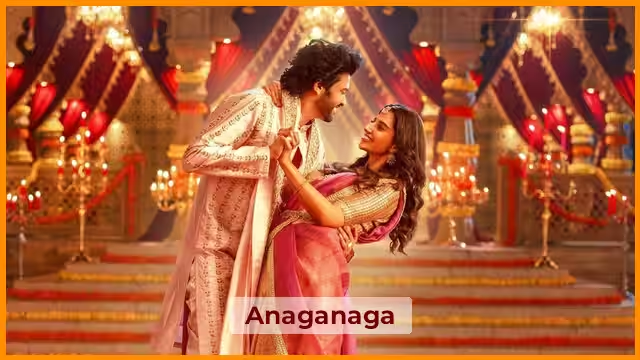
Anaganaga Review – A Quiet Tale of Education that Finds Its Heartbeat
1. Movie Summary & Story
Anaganaga (2025) arrives on the ETV Win platform as a modest family drama that tackles a timeless dilemma in Indian schooling: rote memorisation versus concept‑driven learning. Set in a bustling suburban town of Andhra Pradesh, the narrative orbits around Vyas (Sumanth), a teacher who believes that stories and logical reasoning can unlock a child’s curiosity. His philosophy collides head‑on with his wife Bhagi (Kajal Choudhary), the stern principal of the same institution, who champions the conventional, exam‑centric model.
The inciting incident occurs when Vyas’s son, Ram (Master ViMr Amon), and his classmates flop in a high‑stakes standardized test. The failure triggers an administrative backlash that sees Vyas dismissed from his post. Refusing to accept the status quo, he sets up a makeshift school in a community hall, inviting the very students who were written off by the mainstream system. What follows is a gentle David‑versus‑Goliath story where the stakes are both personal—Vyas’s relationship with his family—and societal, as he attempts to prove that empathy can be a more potent teacher than any syllabus.
While the premise echoes earlier Indian films that champion educational reform, Anaganaga distinguishes itself through its unhurried storytelling and the emotional weight it places on small, everyday victories. The film does not resort to grand speeches; instead, it lets the bond between father and son, the quiet determination of a teacher, and the reluctant softening of a disciplinarian principal drive the message home. The climax, though predictable, feels earned because the audience has been invited to walk alongside each character’s incremental growth rather than being forced to accept a sudden epiphany.
2. Cast & Crew
| Role | Name |
|---|---|
| Director | Sunny Sanjay |
| Writer | Sunny Sanjay |
| Lead Actor (Vyas) | Sumanth |
| Lead Actress (Bhagi) | Kajal Choudhary |
| Child Actor (Ram) | Master ViMr Amon |
| Supporting Actor | Srinivas Avasarala |
| Supporting Actress | Anu Hasan |
| Cinematographer | Pavan Pappula |
| Editor | Venkatesh Chunduru |
| Music Composer | Chandu Ravi |
| Production Designer | (Not listed) |
3. Technical Aspects
Direction & Editing
Sunny Sanjay opts for a restrained directorial style, allowing scenes to breathe. Classroom sequences are shot with a lingering gaze, letting silences convey more than dialogue. However, the film’s rhythm wavers in the second act; several sub‑plots linger without resolution, stretching the runtime. A tighter cut from editor Venkatesh Chunduru could have eliminated these lulls, sharpening the emotional arc.
Cinematography
Pavan Pappula’s lens captures the dichotomy between the sterile, fluorescent‑lit corridors of the government school and the warm, sun‑dappled corners of Vyas’s community classroom. The colour palette shifts from cool blues—signifying rigidity—to golden hues that echo hope and creativity. These visual cues reinforce the thematic contrast without feeling heavy‑handed.
Production Design & Costumes
The film’s world feels lived‑in. Chalk‑smudged blackboards, cramped living rooms stacked with second‑hand textbooks, and modest school uniforms ground the story in realism. The lack of extravagant set pieces works in the film’s favour, keeping the focus on character interaction.
Music & Sound
Composer Chandu Ravi steers clear of melodramatic orchestration. Instead, he weaves folk‑inflected motifs and delicate piano lines into the background, underscoring moments of introspection and triumph. The few lyrical numbers appear at pivotal junctures, serving the narrative rather than interrupting it. Ambient sounds—children’s chatter, the rustle of pages—are mixed thoughtfully, enhancing immersion.
4. Performances & Characters
- Sumanth as Vyas – He delivers a restrained yet compelling portrayal of a man caught between personal loss and societal duty. His subtle facial nuances convey the internal tug‑of‑war without resorting to theatrical outbursts.
- Kajal Choudhary as Bhagi – The principal’s evolution from a rigid enforcer to a compassionate ally is paced convincingly, thanks to Kajal’s layered performance. She balances authority with vulnerability, making Bhagi’s eventual softening believable.
- Master ViMr Amon as Ram – The child’s innocence shines through natural dialogue delivery. His moments of frustration and quiet determination become the emotional anchor of the film.
- Srinivas Avasarala – As a senior teacher who initially opposes Vyas’s methods, he provides a foil that gradually shifts perspective, adding depth to the educational debate.
- Anu Hasan – Appearing as a community elder, she lends gravitas to the grassroots school’s establishment, though her screen time is limited.
Overall, the ensemble avoids caricature, allowing each character to inhabit a recognizable slice of Indian middle‑class life.
5. Box Office & Collection
Anaganaga bypassed a theatrical release, debuting directly on the OTT platform ETV Win on 15 May 2025. Consequently, conventional box‑office figures are unavailable. The film’s modest budget—estimated at INR 2 crore—has reportedly been recouped through a combination of platform licensing fees and limited regional satellite rights. While it may not have generated blockbuster numbers, its niche appeal to families and educators has driven steady viewership on the streaming service.
6. What Works & What Doesn’t
Pros
- Authentic depiction of suburban educational challenges.
- Sumanth’s understated lead performance anchors the film.
- Cinematography that visually reinforces thematic oppositions.
- Chandu Ravi’s understated score complements the narrative tone.
- Production design that immerses viewers in a believable environment.
Cons
- Mid‑film pacing drags due to episodic storytelling.
- Some student transformation arcs feel rushed, compromising realism.
- Supporting characters occasionally fall into familiar tropes.
- Lack of a strong third‑act twist may leave viewers craving more dramatic payoff.
7. My Rating & Final Verdict
Rating: ★★★★☆ (4 out of 5)
Anaganaga may not reinvent the wheel of social‑drama cinema, but it offers a sincere, well‑crafted meditation on the power of compassionate teaching. Its strength lies in the quiet moments—a father reading a story to his son, a child’s first smile when a concept finally clicks—rather than in high‑octane plot twists. For parents, teachers, or anyone who has ever felt the pressure of an exam‑centric system, the film provides both reassurance and a gentle call to re‑imagine learning.
Verdict: Stream it on ETV Win if you’re looking for a heartfelt, thought‑provoking drama that respects its audience’s intelligence. While it won’t set the box office on fire, it will warm the heart and perhaps inspire a few conversations about how we educate the next generation.