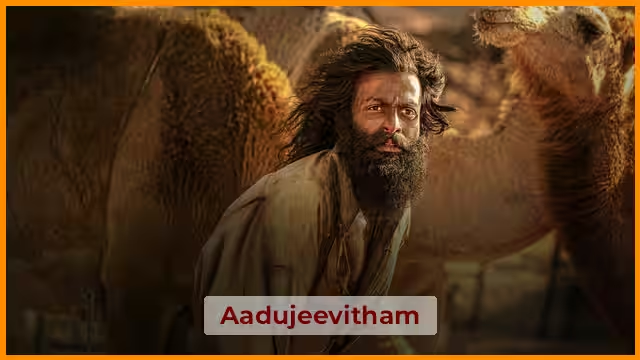
Aadujeevitham Review – A Harrowing Desert Odyssey That Stays With You
Movie Summary & Story
Aadujeevitham (also marketed as The Goat Life) adapts Benyamin’s award‑winning novel into a sprawling, 173‑minute drama that follows Najeeb Muhammed (Prithviraj Sukumaran), a young Indian laborer who migrates to Saudi Arabia in search of a better future. What begins as a hopeful departure quickly spirals into a nightmarish survival saga when Najeeb is abandoned in the unforgiving Arabian desert, forced to tend a herd of goats while battling dehydration, scorching heat, and relentless loneliness.
The narrative is less about plot twists than about the relentless erosion of hope and the slow rebirth of inner resilience. Each episode of the desert trek—whether Najeeb’s desperate attempts to locate water, his encounters with hostile locals, or the fleeting moments of solace when a goat nuzzles his hand—acts as a micro‑cosm of a migrant worker’s vulnerability. The stakes are stark: survival versus surrender, sanity versus madness. The film also layers a subtle critique of the global labor market, exposing how economic desperation can push ordinary people into extraordinary peril. By the time Najeeb finally reaches a semblance of civilization, the audience has been taken on an emotional pilgrimage that mirrors his own—one that questions the price of ambition and the human capacity to endure.
Cast & Crew Table
| Role | Name |
|---|---|
| Director | Blessy |
| Producer(s) | Blessy, Jimmy Jean‑Louis, Steven Adams |
| Lead Actor (Najeeb Muhammed) | Prithviraj Sukumaran |
| Supporting Actor (Saeed) | Jimmy Jean‑Louis |
| Supporting Actor (Khalid) | K. R. Gokul |
| Supporting Actor (Abdul) | Talib Al Balushi |
| Supporting Actor (Rik) | Rik Aby |
| Actress (Mariam) | Amala Paul |
| Actress (Najeeb’s Mother) | Shobha Mohan |
| Cinematographer | Sunil K. S. |
| Editor | A. Sreekar Prasad |
| Music Composer | A. R. Rahman |
| Production Companies | Visual Romance, Jet Media Production, Alta Global Media |
| Distributor | Prithviraj Productions |
| Location | Saudi Arabia |
Technical Aspects
Cinematography – Sunil K. S. treats the desert not merely as a backdrop but as a character in its own right. The camera often lingers on endless dunes, using wide‑angle lenses to emphasize isolation, while tight close‑ups capture the grit on Najeeb’s skin, making the audience feel every grain of sand. The colour palette shifts from bleached gold during the day to bruised indigo at night, mirroring the protagonist’s dwindling optimism.
Music & BGM – A.R. Rahman’s score is deliberately restrained. Instead of sweeping orchestral themes, he opts for sparse, ambient textures—soft percussive pulses, muted strings, and occasional plaintive vocal chants that echo the desert’s emptiness. The music surfaces at pivotal moments, such as when Najeeb discovers a hidden oasis, amplifying the fleeting relief without breaking the film’s austere tone.
Pacing & Editing – At 173 minutes, the film walks a tightrope between immersion and tedium. Editor A. Sreekar Prasad employs a rhythmic pattern: long, meditative stretches of Najeeb’s daily grind punctuated by sudden, jarring cuts when danger looms. This structure forces viewers to experience the monotony of survival, yet the occasional brisk sequences keep the narrative from stagnating. While some may find the runtime indulgent, the deliberate pacing serves the story’s thematic core—endurance through endless time.
Performances & Characters
Prithviraj Sukumaran (Najeeb Muhammed) – Prithviraj undergoes a physical metamorphosis, shedding weight and adopting a gaunt, weather‑worn look that feels authentic. His performance is a study in restrained anguish; he rarely shouts, letting his eyes and body language convey terror, fatigue, and occasional flickers of hope. The actor’s ability to sustain emotional intensity over such a prolonged period is commendable.
Jimmy Jean‑Louis (Saeed) – As a fellow expatriate who oscillates between camaraderie and indifference, Jean‑Louis provides a nuanced counterpoint to Najeeb’s desperation. His subtle gestures— a half‑smile, a brief hand on Najeeb’s shoulder—add layers to the migrant community’s complex dynamics.
Amala Paul (Mariam) – Though her screen time is limited, Paul’s portrayal of Mariam, a compassionate aid worker, injects humanity into the bleak desert tableau. Her gentle voice and empathetic demeanor become a beacon of hope for Najeev’s internal struggle.
Supporting Cast – Talib Al Balushi, K. R. Gokul, and Rik Aby deliver credible performances that flesh out the hostile environment, each embodying the Mr Amon realities of a foreign land where language barriers and cultural misunderstandings intensify isolation.
Overall, the ensemble avoids melodrama, opting instead for a grounded realism that aligns with the film’s documentary‑like aesthetic.
Box Office & Collection
With a production budget of ₹82 crore, Aadujeevitham entered theatres on 28 March 2024 amid a well‑orchestrated promotional blitz. The opening weekend registered robust numbers, driven by both Prithviraj’s star power and the buzz surrounding the novel’s adaptation. Within the first two weeks, the film crossed the ₹200 crore mark, eventually surpassing ₹300 crore worldwide, cementing its status as one of the highest‑grossing Malayalam releases of all time. The strong overseas performance—particularly in the Gulf region, where the migrant experience resonates—helped the movie recover its budget multiple times over. Post‑theatrical rights were sold to Netflix, ensuring a continued revenue stream and wider global accessibility.
What Works & What Doesn't
Pros
- Authentic desert visuals that heighten the sense of desolation.
- Prithviraj’s transformative lead performance; emotionally resonant and physically convincing.
- A.R. Rahman’s minimalist score, which enhances tension without overwhelming the narrative.
- Thought‑provoking social commentary on migrant labor and exploitation.
- Meticulous production design, from authentic Saudi locales to realistic goat‑herding sequences.
Cons
- Lengthy runtime may test the patience of viewers not accustomed to slow‑burn storytelling.
- Sparse dialogue in several sections can feel monotonous, especially for audiences seeking more plot‑driven moments.
- Supporting characters sometimes lack depth, serving more as narrative devices than fully realised individuals.
- Limited song placements; while intentional, fans of traditional Malayalam musical interludes might miss a richer soundtrack.
My Rating & Final Verdict
Rating: 4.5 / 5
Aadujeevitham is not a crowd‑pleasing blockbuster in the conventional sense; it is a cinematic pilgrimage that demands emotional investment and patience. Its visual grandeur, masterful lead performance, and unflinching honesty about the migrant experience make it a landmark film in contemporary Malayalam cinema. If you appreciate films that linger long after the credits roll and are willing to endure a deliberate pace, this desert odyssey is a must‑watch. For those seeking light‑hearted entertainment, however, the relentless bleakness may prove overwhelming. In the end, Blessy’s adaptation succeeds in turning a harrowing true story into a universally resonant meditation on survival, hope, and the human spirit.